Showing posts with label Cliffs. Show all posts

Tuesday, 8 September 2026

Skulferatu #156 - Cat Nick, Salisbury Crags, Holyrood Park, Edinburgh


My walk today took me through Holyrood Park and up Queens Drive with Salisbury Crags towering over me.  As I walked round, I passed a steep path up the hill that leads to the upper road, Radical Road, and to a split in the cliff face there.  This is known as the Cat Nick or Cat Nick Chasm.  The path and the gap in the cliff face used to be a favourite spot for people to walk and then climb up on to Salisbury Crags.  It was said that many of the leading lights in philosophy, poetry, and the Enlightenment, had climbed this, almost as a mark of passage into the intellectual elite.


A view up over some trees to a cliff sitting atop a steep hill.  There is a break in the cliff face - the Cat Nick.  Photo by Kevin Nosferatu for the Skulferatu Project. 
A view of Salisbury Crags and the Cat Nick


A view up a steep hill to a cliff sitting atop it.  There is a break in the cliff face - the Cat Nick.  Photo by Kevin Nosferatu for the Skulferatu Project. 
A view of Salisbury Crags and the Cat Nick


In 1854 the path up to the Cat Nick saw a young man who would go on to be a leading light in world medicine almost come to a sticky end.  Joseph Lister had been persuaded by his friend John Beddoe to walk up this dangerous and steep path.  It would appear that Lister wasn’t too keen on the idea, but after being told by Beddoe how all the great thinkers of the day had done this, he decided to go along with his friend.  About halfway up Lister’s vertigo got the better of him and he told Beddoe that he could go no further and would have to go back down. Beddoe agreed that this may be the best course of action, but as he turned to go down, he slipped and knocked out a boulder that crashed down the hillside catching Lister on the thigh.  Lister was left in agony and Beddoe raced off to get help fearing that his friend’s leg was broken.  Luckily, after being taken down from the hill and carried to the Royal Infirmary, it was found that he had suffered nothing more than severe bruising.  Many years later when Lister had become world famous for his work in using antiseptics to prevent infection in wounds, Beddoe reflected on how close he had come to death that day and on the devastating effect this would have had on the millions of people who would be helped by his discoveries.


A view up a steep hill covered in the yellow blossoming bushes of gorse to a cliff sitting atop it.  There is a break in the cliff face - the Cat Nick.  Photo by Kevin Nosferatu for the Skulferatu Project. 
A view of Salisbury Crags and the Cat Nick


A view over a steep gap looking out over the city of Edinburgh.  Photo by Kevin Nosferatu for the Skulferatu Project. 
View from the Cat Nick


A view over a steep gap looking out over the city of Edinburgh.  Photo by Kevin Nosferatu for the Skulferatu Project. 
View from the Cat Nick


A view over a steep gap looking out over the city of Edinburgh.  Photo by Kevin Nosferatu for the Skulferatu Project. 
View from the Cat Nick


A view looking out over the city of Edinburgh.  In the distance is Edinburgh Castle.  Photo by Kevin Nosferatu for the Skulferatu Project. 
View from the Cat Nick


There is also a much darker tale connected to this spot and to tell it we will first have to travel back in time to Eighteenth Century Ayrshire and an Excise Officer called Mungo Campbell.  Mungo was a man of good education who had joined the Scots Greys, a cavalry regiment in the British Army.  During his time in the army, he saw much action and fought against the Jacobites during the rebellion of 1745.  After the Battle of Culloden and the crushing of the rebellion, Campbell’s relative, Lord Loudoun, arranged for him to be appointed as an Excise Officer.  Campbell took up this post in carried out his duties at various towns and villages around Ayrshire.  Towards the end of his career Campbell’s health was in decline due to lung disease and he was transferred to Saltcoats, which was considered to be one of the easiest areas in Scotland for an Excise Man.  There he married and settled down, leading a relatively quiet life.  In Saltcoats he appeared to be quite a popular figure and was considered to be generous and fair, though he did like a drink and was a bit of a potty mouth with a penchant for blue language.  He was also the sort of man who was very proud and would stand his ground on any point he believed in and would hold a grudge if anyone wronged him.


Campbell was a man who liked to fish and to hunt.  He had licences to do so on the lands around him, with one exception, the land owned by Alexander Montgomerie, the Earl of Eglinton.  The Earl was extremely strict about who could shoot or fish on his land and very rarely granted licences to anyone.  For many years this was not an issue to Campbell until one day in October 1769.  On that day he went out in with two of his colleagues to search the local coastline for any smuggled goods hidden in the sands awaiting collection.  Campbell, being the lead Excise man carried his gun with him in case they met with any violence when trying to seize illicit goods.  They found none and, on their way back to Saltcoats, they cut up from the beach and through Lord Eglinton’s land.  As they walked through his estate a hare suddenly ran out from a nearby bush and Campbell’s hunting instincts kicked in and without thinking, he took aim and shot it.  The shot was heard by Lord Eglinton who immediately demanded that one of his servants go to see what was going on.  The servant sent to investigate, Alexander Bartleymore, was someone who’d had a run in with Campbell, as he had been caught transporting kegs of smuggled rum.  The rum had been seized and destroyed by Campbell and his men.  Since then, Bartleymore had held a grudge against Campbell, so on seeing he had shot a hare on Lord Eglington’s land he demanded that Campbell come with him and explain himself to the Earl.  Campbell obliged and accompanied him back to Lord Eglinton’s house.  There, the Earl raged at Campbell for shooting on his land but eventually accepted Campbell’s explanation and apologies.  Campbell then assured him that it would not happen again.


A few weeks later, on the 24 October 1769, Campbell set out with his colleague John Brown to inspect a few areas along the coastline where they suspected that smuggled goods were being hidden.  Again, they found nothing.  As they returned home, they walked along the beach that ran around the Earl of Eglinton’s land.  Bartleymore happened to see them and thinking he could cause some mischief, he immediately informed Lord Eglinton that Campbell was hunting on his land again.  The Earl, was in his carriage, having just left his home to travel to Fairlie when stopped by Bartleymore, he then left the carriage, took a horse and along with Bartleymore and four other servants, rode out to where Campbell and Brown were on the beach.  He called Campbell a scoundrel, demanded to know why he had been hunting on his land and ordered him to hand over his gun.  Campbell denied that he and Brown had been hunting, pointed out that they did not have a dog with them and that he had shot nothing that day.  He then told the Earl that he would hand his gun over to no man.  The Earl however demanded Campbell’s gun and began walking towards him as if he intended to take the gun by force.  Campbell began to back away from the Earl holding his loaded and cocked gun at his side in a defensive posture, much in the way that he would have been taught to do as a soldier during retreat.  The Earl then asked Campbell if he intended to shoot him and told him that he was just as good a shot as Campbell.  He then told one of his servants to go back to his carriage and fetch his gun.  At this Campbell’s colleague Brown, who was in great fear about what was going to take place, walked away and left the unfolding scene. 


Lord Eglinton then again walked towards Campbell and Campbell retreated, however, as he did so he stumbled on a stone and fell backwards.  According to Campbell, on falling he accidentally fired the gun and shot the Earl by mistake.  However, according to Lord Eglington’s servants, Campbell fell onto his back and the Earl, smiling at Campbell’s fall walked towards him.  Campbell then deliberately fired at close range into the Earl’s belly.  The Earl cried out that Campbell had murdered him, and Campbell threw away his gun.  He was then set on by the Earl’s servants but managed to break from them and tried to grab the Earl’s gun from the servant who had just arrived with it.  They fought briefly before Campbell was overpowered and struck to the ground by the other servants.   The Earl on seeing the beating Campbell was taking from his men cried out to them to not harm him.  They then tied Campbell up and he was transported to Irvine in a cart, while Lord Eglinton was taken in his carriage back to his house.   There, at around midnight the Earl died from his wounds.


Campbell was transported to Edinburgh to stand trial at the High Court for murder.  At his trial Campbell claimed that the shooting had been accidental, and several contemporary newspapers wrote that it seemed likely he would be acquitted as there was evidence his gun had gone off by accident.  However, all Lord Eglington’s servants who had been present at the incident, testified that it had been a deliberate act on Campbell’s part.  That he had aimed and fired the gun a short time after falling.  The doctor who had attended to the Earl also stated that the dying man had told him that Campbell had deliberately shot him.  There were then various arguments by Campbell’s Counsel that the shooting, if deliberate, could be seen as an act of self-defence, given the aggressive actions of the Earl, especially as Campbell was not on his land when confronted by him.  At the conclusion of the trial the jury found Campbell guilty by a majority of nine to six.  The judge then read out the sentence and this was that Campbell – ‘was to be carried back from the bar to the Tolbooth of Edinburgh, therein to remain, and be fed on bread and water only…until Wednesday the eleventh day of April next to come, and upon that day to be taken forth of the said Tolbooth, and carried to the common place of execution in the Grassmarket of Edinburgh; and then and there, betwixt the hours of two and four o’clock in the afternoon of the said day, to be hanged by the neck by the hands of the common executioner, upon a gibbet, until he be dead; and his body thereafter to be delivered to Doctor Alexander Monro…to be by him publicly dissected and anatomized…’


A sketch of several people standing on ground in front of a tall building with steep roofs and a curved tower. 
Edinburgh Tolbooth – from a sketch made in 1817


Campbell had other ideas though and told the friends who had attended the trial that he would not be hanged for murder.  During the night, after his return to the Tolbooth, he hanged himself.  The next morning his body was discovered along with the following note for his wife –


‘You will find, my long and faithful companion, I have kept my word with you – Since I must die because I would not surrender my arms to a tyrannic Lord, I am resolved to avoid being a public spectacle – ‘Ere you receive this I am no more.  May every happiness attend you on earth, and may we meet in eternity, is the earnest wish of your’s even in death.’

Tolbooth, Feb 24 Mungo Campbell


There was then a bit of a legal kerfuffle over Campbell’s body, as his friends argued that it should be returned to them for burial rather than be dissected, as the sentence had not been carried out.  This point was eventually agreed, and his body was handed over.  As Campbell had committed suicide, he could not be buried on consecrated ground, so his friends had him buried at the foot of Salisbury Crags in Holyrood Park.  However, the friends of Lord Eglinton and the citizens of Edinburgh were a bit annoyed that Campbell had managed to avoid being executed.  Feeling they had been deprived of a good hanging, an angry crowd made its way to Campbell’s burial place and dug up his body.  They then carried it up to the summit of Salisbury Crags and threw it off into the chasm at the Cat Nick.


Campbell’s broken body was later recovered by his friends.  Rather than reburying him at the foot of the crags again and running the risk of further indignities being carried out on his body, they had it transported to Leith.  There they hired a small boat and sailed out into the Forth where they weighed his body down and sunk it in the sea.


*           *           *


I don’t think I’ve seen anyone recently walking up this path to the Cat Nick.  I did it once many years ago with some friends, and all I can say about that experience is that I wouldn’t do it again.  Heights and me don’t mix, as I found out.  So, to get round there today, I took the easier route up the gentler slopes by St Margaret’s Well. 


On reaching the Cat Nick I took in the views over Edinburgh before leaving the Skulferatu that had accompanied me in a gap in some rocks nearby.


A photo of a small ceramic skull (Skulferatu #156) being held up with a view out over Edinburgh in the background.  Photo by Kevin Nosferatu for the Skulferatu Project. 
Skulferatu #156


A photo of a small ceramic skull (Skulferatu #156) sitting in a gap in some rocks.  Photo by Kevin Nosferatu for the Skulferatu Project. 
Skulferatu #156 in a gap in rocks by the Cat Nick


A photo of a small ceramic skull (Skulferatu #156) sitting in a gap in some rocks.  Photo by Kevin Nosferatu for the Skulferatu Project. 
Skulferatu #156 in a gap in rocks by the Cat Nick


Apple Map showing the location of Skulferatu #156 
Map showing the location of Skulferatu #156


The coordinates for the location of the Skulferatu are –


Latitude 55.946138

Longitude -3.174302


what3words: eagle.bother.keeps


I used the following sources for information on the Cat Nick -


The Butchering Art

Lindsey Fitzharris

Penguin Books 2017


Historical Tales and Legends of Ayrshire

William Robertson

Hamilton, Adams & Co 1889


The Trial of Mungo Campbell before the High Court of Justiciary in Scotland for the Murder of Alexander Earl of Eglintoun

Robinson and Roberts 1770


Information for Mungo Campbell, Late Officer of Excise at Saltcoats, in a Criminal Prosecution before the High Court of Justiciary in Scotland, for the alleged murder of the late Alexander Earl of Eglinton

Undated


The Newgate Calendar, Volume 4

Ex-classics Project 2009


Traditions of Edinburgh

Robert Chambers

1868


The Castellated and Domestic Architecture of Scotland from the Twelfth to the Eighteenth Century, Volume Five

David MacGibbon & Thomas Ross

1892


Article and photographs are copyright of © Kevin Nosferatu, unless otherwise specified.

Tuesday, 9 April 2024

Skulferatu #117 - Fast Castle, Coldingham, Berwickshire


It looked like a decent day for a walk.  Overcast, but still and cool, though not cold.  The weather forecast had a suggestion of light rain for where I was heading to, however nothing to cause any concern.  Raring to go, I headed off down the east coast, along the A1, the A1107 and then down a single track road to a small and muddy car park just outside the farm at Dowlaw.  Everything was soaking from the recent storms and heavy rains, and I had been warned that the paths around here might be slippy, so I had a decent pair of walking boots on.


Beside the car park was a sign for the footpath to Fast Castle, a place I’d been intending to visit for a while after hearing about how it was perched on a rocky promontory, and surrounded by some precarious cliffs with only a narrow bridge leading to it.  Sounds like fun to me.


A photo showing a wooden signpost standing in a grassy area with trees behind. Three signs are attached to the post.  The top one says Fast Castle and points to the left, underneath is a blue, hand painted sign that reads Castle Car Park and beneath that is a green and white printed plastic sign that gives the months when the sheep on the hills will be lambing.  Photo by Kevin Nosferatu for the Skulferatu Project.
Sign for Fast Castle


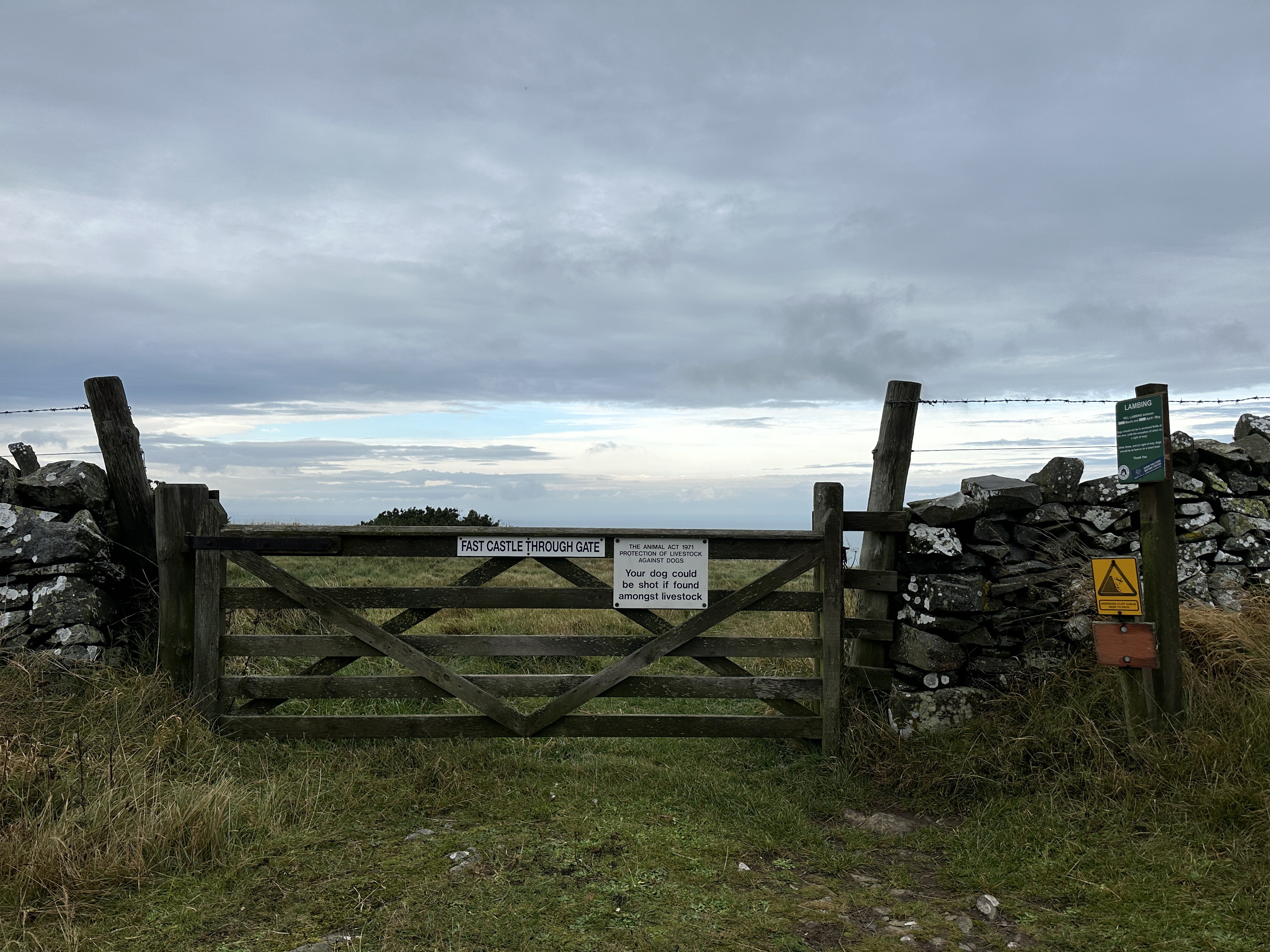
Off I went, down a sodden and muddy path through a bit of woodland and over a stile with a warning sign on it about the unfenced cliff ahead.  After a short walk into some fields, I came to a gate with various warning signs on it and another about the unfenced cliff ahead.  KEEP TO THE PATH it warned me.  Well not to worry, given my severe dislike of heights I wouldn’t be deviating from the path to peer over any cliff edges.


A photo of a wooden gate in a stone wall.  A sign on it reads - Fast Castle through gate. Photo by Kevin Nosferatu for the Skulferatu Project.
Gate to castle footpath


A photo of a yellow warning sign.  The sign has a cartoon picture of a person falling off a cliff.  Underneath this image it states - Unfenced Cliff Ahead Keep to Path. Photo by Kevin Nosferatu for the Skulferatu Project.
Unfenced Cliff Ahead Keep to Path


A narrow, stony path then led through a hillside of winter brown heather, with a view over the North Sea.  A sea with huge swelling waves that rumbled against the nearby cliffs.  A sea still angry and swollen by the recent storms.


As I walked through the heather, I got a view of a further hillside of green fields dropping down and down to the steep cliffs where the ruins of the castle stood.  The scattered remains of the castle looked like the jagged teeth of an ancient, broken jawbone.


A photo of a gravel and dirt path going through a scrubby area of brown heather.  On the left-hand side can be seen a dark cold looking sea with ominous dark clouds above. Photo by Kevin Nosferatu for the Skulferatu Project.
Path through winter brown heather


A photo looking down a hill towards the sea.  In the distance can be seen a piece of land jutting out with some ruins on it. Photo by Kevin Nosferatu for the Skulferatu Project.
The distant remains of Fast Castle


The path, which had become one of sodden red earth, then became narrower and narrower as it led me down the hill.  In parts it had almost become a small stream from the water flowing off the land above.  I came to some wood framed steps that then led down to a path that cut perilously close to the cliff edge.  Well, I say that, but on a lovely dry summer’s day, it would probably be fine.  However, on a wet day it didn’t look the safest being narrow, muddy, and next to a short ledge of wet grass angled at a degree that would make a great slide to, and over, the cliff edge. In my imagination I could easily visualise myself slipping and then sliding off into oblivion.  Putting my fear, and fevered imagination, to one side, I cut carefully along the path to an area where the land widened out again.  An area beside some rocks that were covered in lichens.  More lichens than I think I’ve ever seen before.  The rocks were a mass of grey green lichens looking out towards the sea.  After passing by these rocks, the ruins of the castle came into view, and I walked over to the narrow concrete bridge leading over to it.


A photo showing a grassy area that drops away suddenly in a plunge down to the sea. Photo by Kevin Nosferatu for the Skulferatu Project.
Steep drop down from the footpath


A photo showing a jutting piece of land with some broken stone walls on it. Photo by Kevin Nosferatu for the Skulferatu Project.
Ruins of Fast Castle


A photo showing a ruined wall running along a steep cliff.  The wall is one of the last parts remaining of Fast Castle. Photo by Kevin Nosferatu for the Skulferatu Project.
Ruins of Fast Castle


A photo showing a ruined wall running along a steep cliff.  The wall is one of the last parts remaining of Fast Castle. Photo by Kevin Nosferatu for the Skulferatu Project.
Ruins of Fast Castle


A view of a path with a chain link fence running over to the ruined walls of Fast Castle. Photo by Kevin Nosferatu for the Skulferatu Project.
Path to Fast Castle


photo showing a narrow concrete bridge leading over to a rocky promontory with some jutting ruined walls on it. Photo by Kevin Nosferatu for the Skulferatu Project.
Bridge over to Fast Castle


Crossing the bridge was fun, in a hair raising way.  The rusting iron chains at each side are low and on reaching the steps up to the promontory there is a slab of rock that cuts through them at an angle, meaning that I had to go towards the cliff edge, and a sheer drop to certain death, to get up.  By the steps I spotted another chain hanging down which I used to help me scramble up onto the steps and then over onto the castle grounds.  That was when the rain started.


I wandered around the sparse remains of the castle and looked out on the stunning views over the coast and the sea.  I wondered what it must have been like to look out over a storm raging sea from the castle when it was in its heyday.  Spectacular and slightly frightening I would imagine.  Below me the sea boomed against the rocks with a violence that could almost be felt in the ground beneath my feet.


A photo looking out over a rough bit of land with some clumps of stone that once made up the walls of Fast Castle. Photo by Kevin Nosferatu for the Skulferatu Project.
Clumps of ruined walls


A photo of a ruined piece of the wall that in shape resembles an upside-down triangle.  Along from it the land drops away to the sea. Photo by Kevin Nosferatu for the Skulferatu Project.
Part of the castle wall


A view showing the land dropping down to an angry looking sea where the white foam of the waves is roaring up around a rocky outcrop there. Photo by Kevin Nosferatu for the Skulferatu Project.
View out to sea


A view of a grey looking rocky coastline with ominous clouds above and waves crashing against the cliffs. Photo by Kevin Nosferatu for the Skulferatu Project.
View over the coast


On making my way down to the far end of the land on which the castle had stood, I came to a triangular section of wall perched by the cliff edge.  The cement between the rocks was wet and crumbling and I wondered how soon it would be before this too collapsed into the sea.  There was a path by it that led to the cliffs facing out to the sea.  I thought about cutting down it for a view out, but it was so wet and boggy that I decided against it.  I didn’t really fancy the idea of ending up in the sea and being washed out into the ocean, to never be seen again.


As I cut back along past the fallen piles of rock and crumbling wall remains of the castle the rain really came in.  Not the light rain that had been forecast, but heavy, heavy rain.  The sort of rain that hits so hard it almost bounces back off the ground.  I took shelter by one of the crumbling walls and tried my best to keep out of the downpour.  As the rain poured on and on, I wondered about those who had lived and served in this castle all those years ago.  For a small castle on an inaccessible and inhospitable outcrop of rock, Fast Castle has a rich history.


Fast Castle is one of these places where very little is known about its beginnings.  Evidence was found that the peninsula on which it sits had been inhabited in the iron age, though the first time the castle is recorded is in 1333.   In the early days of the castle, it was occupied by an English garrison that used it as a base to harry and pillage the local villages and towns. This tradition was carried on by various English governors of the castle, the last of these being Thomas Holden.  In 1410 the castle was seized from him in a surprise attack by Patrick Dunbar, son of the Earl of Dunbar, with ‘a hundred hardie followers.’


The castle then had various owners until it was acquired by Patrick Home in 1488.  Home appears to have been a bit of a thug and it is recorded, that given his reputation, Officers of the Crown were in fear of their lives when trying to serve summonses on him, instead pinning the notices to church doors.  At one time, Patrick and his brother seized Coldingham Priory, threw the clergy out, and took the lands as their own.  For this Patrick was excommunicated by the Pope, which was a pretty big deal back then.  In 1500, Patrick was given charge of several prisoners who had been accused of taking part in the murder of Sir Robert Ker, the Warden of the Middle Marches who was responsible for border security.  Patrick held the men in confinement at Fast Castle, and there they all quickly, and conveniently, died.


In 1503, Patrick and his wife played host for a night to Margaret Tudor at Fast Castle.  Margaret was on her way to Holyrood to marry James IV.  A huge number of followers came with her, though most of them were housed at Coldingham, the castle not being big enough to house them all.   When Margaret departed the next day it was recorded that she was ‘attired in a rich riding dress and mounted on a beautiful white pony, with footmen on either side…with portcullises embroidered on their jackets.’  As she left canons were fired from the castle walls to celebrate her visit and forthcoming marriage.


On the death of Patrick, the castle was inherited by his son, Cuthbert.  He, however only had the castle for a few years before being killed in 1513 at the Battle of Flodden, where the Scottish army was defeated, and King James IV was killed.  Chaos then reigned in Scotland for several years as the Duke of Albany fought various other factions for control.  Alexander Home, who had inherited the castle, had originally been a supporter of the Duke of Albany but turned against him.  For this he was taken prisoner and executed.  Albany also had Fast Castle captured and partially destroyed. 


In 1521, the castle was rebuilt, after it, along with the Homes estates, were restored to George Home.  However, the castle again changed hands when in 1547 it was captured by the English army during the ‘Rough Wooing’.  It was then recaptured by the Scots in 1549 when a group of men gained entry by pretending to be locals supplying food that had been ordered.  On entering the castle, they took the soldiers stationed there by surprise and seized control of it.  Something that may not have actually been that difficult as it seems that only around twelve or so soldiers were stationed there.


In 1567, Fast Castle hosted a meeting between the English ambassador, Sir Nicholas Throckmorton, and various Scottish nobles.  The agenda of this meeting was to discuss Mary, Queen of Scots, who was at that time being held prisoner in Lochleven.  The meeting appears to have reached no resolution though Throckmorton did comment on how uncomfortable his stay at the castle had been, writing that it was ‘fitter to lodge prisoners than folks at lybertye…


A black and white etching of a view down to a ruinous tower like building that is crumbling and has almost split into two.  Some figures stand in the foreground looking towards the castle and in the background is the sea with a sail boat passing by.
Fast Castle by John Thomson


A drawing of a view from the rocks by the sea along from Fast Castle.  The castle is perched above and looks to be a round tower with a ruined outer wall of some other part of the building by it.
Fast Castle from the Sea by John Thomson


In 1570, the castle was again captured by the English after Queen Elizabeth suspected that it was being used to help Catholic rebels from England escape.  After being held by the English for several years, the castle ended up with the Logan family and with probably its most notorious owner, Robert Logan.


Robert Logan was a bit of a ne'er-do-well, being described as ‘ambitious, expensive, avaricious…and unscrupulous.’  He had several run-ins with those in power due to his involvement with people seen as traitors to King James VI, and he also appears to have committed several robberies, or had his servants commit them on his behalf.  Always on the lookout for money, he came to the belief that there may be buried treasure at Fast Castle.  In hope of finding this he entered into a contract with John Napier, the mathematician and occultist, in which he tasked Napier to ‘search and seek out, and by all craft and ingine to find out the same, or make it sure that no such thing has been there.’  It seems likely that Napier never carried out the search and no gold or treasure was recovered from the castle.  However, none of this is what Logan is really remembered for, what made him infamous was his involvement in the Gowrie Conspiracy.


On 5 August 1600, King James VI was out hunting with his courtiers, when he was approached by Alexander Ruthven, brother of the Earl of Gowrie, and was invited to attend at Gowrie House, where he was told a foreigner, who was probably a spy, had been seized and was in possession of a large amount of money.  The King was at first reluctant to go, but was eventually persuaded that the money could be his to confiscate if he attended at the house and questioned the supposed spy.  So, off the King rode with his large retinue alongside him, and a few hours later arrived at Gowrie House.  There he was wined and dined before being shown into an attic room where the prisoner was supposedly being held.  On entering the room, he was confronted by an armed man, one of Alexander’s servants.  Alexander then held a knife to the King’s chest and told him that if he tried to escape or raise the alarm he would be killed.  Leaving the King with the servant, Alexander made his way to the courtyard, where the King’s retinue were waiting, and told them that the King had just left and expected them to follow.  Alexander returned to the room where the King was being held and a struggle then broke out during which the King managed to force open one of the windows and shout for help.  Members of his retinue, who had not yet left the courtyard, heard his cries, and ran to the room to save him.  During the ruckus that followed, Alexander was killed.  His brother John, the Earl of Gowrie, then arrived on the scene.  Seeing his brother’s body, he drew his sword and ran at the King’s followers.  They promptly killed him.


So how, you may ask, was Robert Logan involved?  Well, a few years after his death, Logan’s lawyer, George Sprot confessed that he had various letters from the Earl of Gowrie to Logan in which they discussed a plot to kidnap the King.  The plot appears to have been that the Gowrie brothers would seize the King and take him to a boat on the Tay, the river that ran past Gowrie House.  He would then be taken to Fast Castle and held there, probably so that someone else, maybe the Earl of Gowrie, could then seize the throne.  For his part in this, Robert Logan was to be given the nearby, and much nicer, castle at Dirleton. 


Sprot’s confession led to the bizarre scene of Logan’s bones being dug up from his grave and then taken to court for trial.  There he was found guilty of treason and the few properties his family had remaining were forfeited.


It is not clear how much of the Conspiracy was real and how much just imagined or made up.  Many believed that the King had attended at Gowrie House with the express intent of taking revenge on the Gowrie’s and seizing their lands.  After all, they had made the life of his mother, Mary Queen of Scots, miserable, as not only had they been her captors at one point, but they had also been complicit in the murder of her favourite courtier, David Rizzio and also her husband Darnley.  However, there is also the matter of the letters.  These were examined by various people who had known and had dealings with Logan and the Earl of Gowrie.  They testified that the writing was theirs.  So, was there a conspiracy?  Well, kidnap, extortion and power grabs were pretty common back then, so, there is a good chance this took place.  However, we’ll never know for sure.


One thing that Logan’s infamy led to though, was that he became a bit of a bogeyman.  Tall tales and legends spread about his evil doing, especially around Leith, as his family home at Lochend Castle in Restalrig was nearby.  It was said that he had an uncontrollable lust and would have a giant henchman of his seize any woman he took a fancy to.  He would then take them to his lair at Lochend castle and force himself upon them. 


One day Logan was passing by the house of a wealthy Leith merchant when he spotted his daughter looking out from one of the windows.  She was renowned for her beauty and Logan became obsessed with her, having his coach drive past her house numerous times a day to catch a glimpse of her.  Deciding that he must have her, Logan ordered his giant henchman to take her.  The giant then broke into the house at night and seized her from her bedroom.  When the girl was discovered to be missing there was a huge hue and cry, and the townsfolk demanded that Logan hand the girl back.  He denied any knowledge of her disappearance and swore that he was innocent of any wrongdoing.  Logan’s giant henchman was killed by a group of angry Leith locals shortly after this, and legend has it that he is buried at Giant’s Brae in Leith Links.  A few months later Logan’s reputation was in tatters, and he had sold most of his lands off, including Fast Castle.  It was then that the missing girl was found, locked in the dungeons of the castle, but otherwise safe and unharmed.


Anyway, getting back to Fast Castle, it went through several more owners, before being abandoned and falling into ruin.  In 1871 much of it was destroyed in a lightning strike.


Rumours about there being buried treasure in the castle grounds have persisted down the years.  It is said that there is over £1 million in Spanish gold buried there.  Money that was brought over from Spain to finance a Spanish invasion of England through Scotland.  In the 1970s a team of treasure hunters were given permission to look for the gold.  They found none, but they did find the centuries old skeleton of a man who appeared to have been murdered, some broken pieces of pottery, a few bronze items, and a musket ball.


***


After a good ten minutes of sheltering from the rain there was a lull and I decided to make my way back out from the castle ruins.  As I approached the concrete bridge, I left a Skulferatu in a crumbling piece of wall just in front of it.  I then carefully made my way down the steps and back across the bridge.  Then having just made it past the scary bit of path by the cliff edge, the rain started again.  Heavy, heavy rain that soaked me through within minutes.  My vision of what was around me was almost nil given the ferocity of the rain, so head down I looked only at my feet as they squelched up the running river that had been the muddy path.  Sticking religiously to the path I soon arrived back at the car, a soggy wet mess.  A soggy, wet mess desperate for a cup of tea.  I really should have brought a flask.  Well, hopefully I’ll remember to do that next time.


A photo of a crumbling piece of a thick stone wall standing next to a cliff edge. Photo by Kevin Nosferatu for the Skulferatu Project.
Crumbling piece of the castle wall


A photo showing a hand holding up a small, ceramic skull (Skulferatu 117) with one of the crumbling walls of Fast Castle in the background. Photo by Kevin Nosferatu for the Skulferatu Project.
Skulferatu #117


A photo showing a small, ceramic skull (Skulferatu 117) sitting in a gap in one of the crumbling walls of Fast Castle.  Photo by Kevin Nosferatu for the Skulferatu Project.
Skulferatu #117 in the crumbling wall


A photo showing a close up of the small, ceramic skull (Skulferatu 117) sitting in a gap in one of the crumbling walls of Fast Castle. Photo by Kevin Nosferatu for the Skulferatu Project.
Skulferatu #117 in the crumbling wall


TomTom Map showing location of Skulferatu #117
Map showing location of Skulferatu #117


The coordinates for the location of the Skulferatu are –


Latitude 55.932447

Longitude -2.223772


what3words: lushly.snacks.polka


I used the following sources for information on Fast Castle –


The Miscellaneous Prose Works of Walter Scott, Vol VII
Provincial Antiquities
1848
 
John Thomson of Duddingston
By William Baird
1907
 
The Gateway of Scotland
East Lothian, Lammermoor & the Merse
A.G. Bradley
1912
 
The Royal Commission of the Ancient and Historical Monuments and Constructions of Scotland
Sixth Report and Inventory of Monuments and Constructions in the County of Berwick
1915
 
Proceedings of the Society of Antiquaries of Scotland
Vol LV, Fifth Series – Vol VII
1921
 
Edinburgh Evening News – Saturday 21 May 1927
 
The Scotsman – Monday, June 23, 1969
 
The Scotsman – Tuesday, August 26, 1969
 
Canmore
 
 Wikipedia